Search for “types of camera shots” and you will find lists of 7, 12, 20 and even 50. They are not exactly wrong. They are just mixing different things together. A close-up, a low angle and a dolly are not three kinds of shot. They are three answers to three different questions about the same shot. Once you see that, the whole vocabulary snaps into place.
In this guide
- Why every list gives a different number, and the simple fix
- Shot sizes, from the extreme long shot to the extreme close-up
- Camera angles: height, tilt and the Dutch angle
- Camera movement: pan, tilt, dolly (or trolley), tracking, crane, handheld, Steadicam
- Lens and focus moves, and why a zoom is not a dolly
- Shots named for what they show: establishing, two-shot, over-the-shoulder, POV, insert
- Shots named for time: the long take
- How to write any shot on a shot list in one line
Why nobody agrees on the number
Most lists put “close-up”, “high angle”, “pan” and “over-the-shoulder” side by side as if they were the same kind of thing. They are not. Every shot in a film can be described in several ways at once:
- Size: how much of the subject fills the frame. Close-up, medium shot, long shot.
- Angle: where the camera sits in relation to the subject. High, low, eye level, overhead, tilted.
- Movement: whether the camera itself moves, and how. Pan, tilt, dolly, crane, handheld.
- Lens and focus: changes made in the lens, not by moving the camera. Zoom, rack focus, deep focus.
- Content and purpose: what the shot shows or what job it does in the scene. Establishing shot, two-shot, over-the-shoulder, point of view, insert.
Some writers add a sixth: time, as in the long take, a shot that runs for minutes without a cut.
So one shot can be, all at once, a medium close-up (size), from a low angle (angle), with a slow dolly in (movement), on a long lens with shallow focus (lens), of one character (a single). That is one shot with five labels, not five types of shot. A list of “12 types” usually takes a few items from each group and stops there. That is why the numbers never match.
This is not a new idea. Joseph V. Mascelli’s classic The Five C’s of Cinematography (1965) already separated camera angles, close-ups, continuity, cutting and composition into different chapters. Film textbooks such as Bordwell and Thompson’s Film Art treat framing distance, angle and camera movement as separate parts of the frame too. The rest of this guide follows that logic, one question at a time.
| Question | Group | Common examples |
|---|---|---|
| How much do we see? | Shot size | Extreme long, long, full, medium long, medium, medium close-up, close-up, extreme close-up |
| From where? | Camera angle | Bird’s-eye, high, eye level, low, worm’s-eye, Dutch |
| Does the camera move? | Camera movement | Pan, whip pan, tilt, dolly (trolley), truck, tracking, pedestal, crane, arc, handheld, Steadicam or gimbal, aerial |
| Does the lens change? | Lens and focus | Zoom, crash zoom, dolly zoom, rack focus, deep focus, shallow focus |
| What does it show, and why? | Content and purpose | Establishing, master, single, two-shot, group, over-the-shoulder, point of view, reaction, insert, cutaway |
| How long does it last? | Time | Long take (oner), and its opposite, rapid cutting |
1. Shot size: how much we see
Shot sizes are measured against the human body. That is why the definitions talk about knees, waists and chins. Bordwell and Thompson’s Film Art describes each size by what fills the screen: in a long shot a standing figure is small in the frame; in a medium shot the figure is seen from the waist up; in a close-up it is usually the head from the neck up. The same textbook stresses that the boundaries are flexible. One cinematographer’s medium close-up is another’s close shot. What matters is the effect.
Extreme long shot (ELS) or extreme wide shot
The landscape, city or crowd fills the screen and people are tiny or invisible. It tells the audience where we are and how big the world is compared with the people in it. It is often used as an establishing shot at the start of a sequence.
Long shot (LS) or wide shot (WS)
The whole figure is visible, but the setting still dominates. Use it when the relationship between a person and their surroundings is the point: a lone figure on an empty road, a family in a crowded room.
Full shot (FS)
The figure fills the frame from head to feet. Good for showing body language, costume and physical action such as dance or fighting.
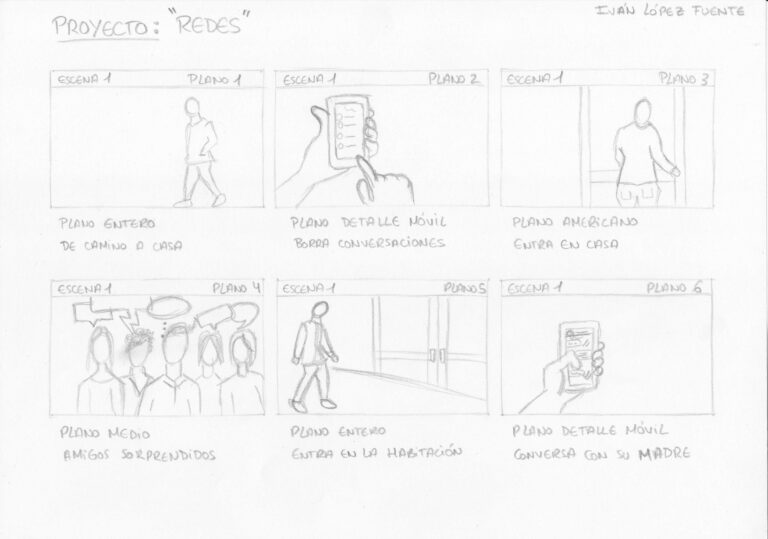
Medium long shot (MLS), also called the American shot or cowboy shot
The figure is framed from about the knees up. Film Art notes that the French term plan américain is used for this size when it frames people. The nickname “cowboy shot” is usually linked to Westerns, where the frame line sat low enough to show a gun on the hip.
Medium shot (MS)
From the waist up. It is close enough to read faces and gestures and wide enough to keep some of the setting. Much everyday dialogue, from news presenters to sitcoms, sits at this size.
Medium close-up (MCU)
From the chest or shoulders up. Attentive but polite. It is the standard size for interviews, including documentary interviews, because it shows expression without crowding the speaker.
Close-up (CU)
Mostly the face, usually cut around the neck or the top of the shoulders. The audience can now see small changes in the eyes and mouth. Close-ups are powerful because they are rarer than other sizes. Use them everywhere and they stop meaning anything.
Extreme close-up (ECU or XCU)
A detail: eyes, a mouth, a finger on a trigger, a ring. It isolates one thing and makes it enormous. Sergio Leone’s The Good, the Bad and the Ugly (1966) builds its famous three-way standoff by cutting between extreme close-ups of the gunfighters’ eyes and wider shots of the arena.
For a deeper look at each size and what it does to an audience, read our guide to shot sizes and camera angles.
2. Camera angle: from where we see it
Angle is about the camera’s height and which way it points up or down, relative to the subject. The common angles run from straight overhead to straight up from the ground.
Bird’s-eye view, overhead shot or top shot
The camera looks straight down. It turns people and objects into patterns and can make a character feel watched or trapped. Busby Berkeley’s 1930s musical numbers used overhead shots to turn rows of dancers into moving geometric shapes.
High angle
The camera is above eye level, looking down at an angle. It tends to make the subject look smaller, weaker or more exposed. It is not the same as a bird’s-eye view: a high angle still sees the subject from the side, at a slant.
Eye level
The camera sits at the subject’s eye height. It is the most neutral angle and the one audiences notice least. Documentary interviews are usually shot at eye level because it treats the speaker as an equal.
Shoulder, hip and ground level
Some cinematographers also name camera heights that sit between the main angles: shoulder level, hip level and ground level. These describe where the camera is placed rather than a strong tilt up or down. A hip-level camera is common in Westerns for the same reason as the cowboy shot.
Low angle
The camera is below eye level, looking up. It tends to make the subject look bigger, stronger or more threatening. It also changes the background: looking up often shows ceilings or sky instead of floor.
Worm’s-eye view
An extreme low angle, from ground level looking almost straight up. It exaggerates height and can make buildings or people seem to tower over the viewer.
Dutch angle (canted or oblique angle)
The camera is rotated sideways, so the horizon is tilted. Strictly, this is a roll of the camera rather than a change of height, which is why it sits slightly apart from the others. It suggests unease, disorientation or a world out of balance. Carol Reed’s The Third Man (1949) is the textbook example: cinematographer Robert Krasker tilted the camera through much of post-war Vienna, and won the Academy Award for Best Black-and-White Cinematography for the film.
3. Camera movement: when the camera itself moves
Here is where most confusion happens, because the names come from the equipment and different countries use different words. It helps to split movement into two families: the camera turns on the spot, or the camera travels through space.
The camera turns on the spot
Pan. The camera rotates left or right on a fixed point, usually a tripod head, like turning your head to follow a passing car. It reveals space or follows action across the frame.
Whip pan (swish pan). A pan so fast the image blurs. It is used for energy, for comedy, or as a transition: a whip pan out of one scene can cut to a whip pan into the next.
Tilt (tilt up, tilt down). The camera rotates up or down on a fixed point, like nodding your head. Tilting up a tall building or from a character’s shoes to their face are classic uses. People often say “pan up”, but on set that move is a tilt.
The camera travels
Dolly (dolly in, dolly out), also called a trolley shot. The whole camera moves towards or away from the subject, usually on a wheeled platform called a dolly, often running on tracks. “Trolley” is the same idea under another name, common in British and South Asian film crews. A dolly in, also called a push in, moves the audience closer to a character, often at a moment of realisation. A dolly out pulls away, leaving a character isolated.
Truck (truck left, truck right). The camera moves sideways, parallel to the subject. Many crews simply call this a lateral dolly or crab.
Tracking shot. The camera follows a moving subject, beside, ahead of or behind them. The name comes from the tracks laid for the dolly, but today a tracking shot can be done with a vehicle, a Steadicam, a gimbal or a drone. In practice crews use “dolly shot” and “tracking shot” loosely, so it is worth confirming what is meant.
Pedestal (ped up, ped down). The whole camera rises or lowers straight up and down without tilting, as on a studio camera pedestal. It is different from a tilt, where the camera stays at the same height and changes direction.
Arc shot. The camera travels in a curve around the subject, keeping them in frame. It can heighten a moment, such as two characters seeing each other for the first time.
Crane, jib or boom shot. The camera is mounted on an arm that can rise, fall and sweep through the air. Cranes can begin high above a scene and come down into it, or rise away at the end of a film. The opening shot of Orson Welles’ Touch of Evil (1958), photographed with Russell Metty, is a famous crane shot that runs for more than three minutes without a cut, following a car with a bomb in its trunk through a border town.
Handheld. The camera is held by the operator, with no stabilising device, so it moves with their body. It feels immediate, nervous or documentary-like, and it is a natural choice for observational documentary.
Steadicam and gimbal shots. The camera is carried by an operator but stabilised, so it glides instead of shaking. The Steadicam, invented by Garrett Brown, was first used in a feature on Bound for Glory (1976), and became famous the same year with Rocky’s run up the steps of the Philadelphia Museum of Art. In Goodfellas (1990), operator Larry McConkey used a Steadicam to follow Henry and Karen through the back corridors and kitchen into the Copacabana nightclub in one continuous shot. Today handheld electronic gimbals do a similar job on a far smaller budget.
Aerial or drone shot. The camera flies, on a helicopter, plane or drone. It is mostly used for extreme long shots and dramatic reveals. Always check local drone laws before flying.
For what each movement makes an audience feel, read our guide to camera movement.
4. Lens and focus: when the image changes but the camera does not move
These shots are often listed as “movement”, but the camera can stay completely still. The change happens inside the lens.
Zoom (zoom in, zoom out)
A zoom lens changes its focal length during the shot, so the frame gets tighter or wider while the camera stays put. Stanley Kubrick’s Barry Lyndon (1975) is known for its slow zoom-outs, which often begin on a detail and pull back to reveal a wide landscape, making the characters small against a painting-like world.
Crash zoom or snap zoom
A very fast zoom in or out. It hits like an exclamation mark and is common in action films, Westerns, kung fu films and comedy.
Why a zoom is not a dolly
This is the most common mix-up, and it matters, because the two look different on screen.
- A dolly moves the camera. As it moves, things in the foreground pass by faster than things in the background. This change in perspective, called parallax, makes the audience feel they are physically moving through the space.
- A zoom moves nothing. It magnifies or shrinks the image from one fixed point, like cropping a photograph. The relationship between foreground and background stays the same, only bigger or smaller. It feels more like the eye of an observer than the body of someone walking in.
A simple test: if the background seems to slide behind the subject, the camera moved. If the whole picture simply grows or shrinks, it was a zoom.
Dolly zoom (the Vertigo effect)
Combine the two in opposite directions and you get one of cinema’s strangest effects. The camera dollies towards the subject while the lens zooms out, or the reverse, so the subject stays the same size but the background seems to stretch or rush in. It was devised by Paramount camera operator Irmin Roberts for Alfred Hitchcock’s Vertigo (1958) to show the hero’s fear of heights. Steven Spielberg used it in Jaws (1975) on Chief Brody’s face at the moment he sees the shark attack on the beach. It is also called the Hitchcock zoom or contra-zoom.
Rack focus (pull focus)
The focus shifts during the shot from one subject to another at a different distance, for example from a character in the foreground to a door opening behind them. It moves the audience’s attention without moving the camera.
Deep focus and shallow focus
These describe how much of the image is sharp. In deep focus, foreground, middle and background are all sharp at once, so the audience chooses where to look. Gregg Toland’s cinematography on Orson Welles’ Citizen Kane (1941) is the classic example. In shallow focus, only a thin slice of the image is sharp and the rest blurs, isolating the subject. How much is in focus depends on the lens, the aperture and the distance, which our guide to camera lenses explains in detail.
5. Shots named for what they show
These names describe the shot’s content or its job in the scene. Most of them still have a size, an angle and a movement too.
Establishing shot
Usually the first shot of a scene, often a long or extreme long shot, showing where we are: the outside of a building, a street, a village. It orients the audience before the scene moves closer.
Master shot
A shot that records an entire scene, usually wide enough to include all the characters, from start to finish. Editors cut back to it whenever they need to remind the audience where everyone is. Closer shots are then filmed as coverage.
Single, two-shot and group shot
Named for how many people are in the frame: one (a single), two (a two-shot) or more (a three-shot or group shot). A two-shot keeps both people in the same frame, so their relationship can be seen without a cut.
Over-the-shoulder shot (OTS)
Filmed from behind one character, with part of their shoulder and head in the foreground, looking at the person they are talking to. It is the backbone of dialogue scenes because it keeps both people connected while favouring one. Mascelli treats it alongside close-ups in The Five C’s of Cinematography.
Point-of-view shot (POV)
The camera shows exactly what a character sees, as if through their eyes, usually after a shot of them looking. The opening of John Carpenter’s Halloween (1978) is a famous extended POV shot: the audience sees through the killer’s eyes before learning who he is.
Reaction shot
A shot of a character responding to something said or done, often in silence. Many scenes are carried by reactions rather than by the person speaking.
Insert and cut-in
A close shot of a detail that matters to the story: a letter, a phone screen, a hand on a door handle. A cut-in moves closer to something already visible in the wider shot.
Cutaway
A shot of something outside the main action, such as a clock, the view from a window or a bystander, that the editor can cut to. Cutaways help condense time and hide cuts, which is why documentary editors always want plenty of them.
6. Shots named for time: the long take
A long take, sometimes called a oner or, in French, a plan-séquence, is a single shot that runs much longer than usual without a cut. It is defined by duration, not size or angle. A long take can be static or moving, wide or close. The Touch of Evil opening and the Goodfellas Copacabana shot are both long takes as well as moving shots, which shows again how one shot can belong to several groups at once.
Do not confuse a long take with a long shot. A long shot is about distance. A long take is about time.
How to name any shot on a shot list
With the groups above you can describe any shot in one line. A simple order that crews understand:
Size + angle + movement or lens + subject + purpose (if needed).
- “ELS, high angle, static: the village at dawn (establishing).”
- “MCU, eye level, slow push in: Amina, as she hears the news.”
- “OTS on Karim, eye level, static: favouring Amina.”
- “CU insert, overhead: the letter on the table.”
- “LS, low angle, handheld, tracking: the crowd moving towards the gate.”
Leave out anything that is the default. If a shot is at eye level and static, you often do not need to say so.
Quick reference
| Term | Group | What it means in one line |
|---|---|---|
| Extreme long shot | Size | Setting dominates; people are tiny |
| Long shot / wide shot | Size | Whole figure visible, setting still important |
| Full shot | Size | Figure fills the frame, head to feet |
| Medium long shot | Size | Knees up; also American or cowboy shot |
| Medium shot | Size | Waist up |
| Medium close-up | Size | Chest or shoulders up |
| Close-up | Size | Face fills most of the frame |
| Extreme close-up | Size | One detail: eyes, mouth, object |
| Bird’s-eye / overhead | Angle | Straight down from above |
| High angle | Angle | Above eye level, looking down |
| Eye level | Angle | At the subject’s eye height; neutral |
| Low angle | Angle | Below eye level, looking up |
| Worm’s-eye | Angle | From the ground, looking almost straight up |
| Dutch angle | Angle | Camera rolled; horizon tilted |
| Pan | Movement | Camera turns left or right on the spot |
| Whip pan | Movement | A pan so fast it blurs |
| Tilt | Movement | Camera turns up or down on the spot |
| Dolly / trolley | Movement | Camera travels towards or away from the subject |
| Truck | Movement | Camera travels sideways |
| Tracking shot | Movement | Camera follows a moving subject |
| Pedestal | Movement | Camera rises or lowers without tilting |
| Arc | Movement | Camera circles the subject |
| Crane / jib | Movement | Camera on an arm, sweeping up, down or over |
| Handheld | Movement | Held by the operator, unstabilised |
| Steadicam / gimbal | Movement | Carried but stabilised; glides |
| Aerial / drone | Movement | Camera flies |
| Zoom | Lens | Focal length changes; camera stays still |
| Crash zoom | Lens | A very fast zoom |
| Dolly zoom | Lens + movement | Dolly and zoom in opposite directions; background warps |
| Rack focus | Lens | Focus shifts between subjects during the shot |
| Deep focus | Lens | Near and far both sharp |
| Shallow focus | Lens | Only a thin slice sharp |
| Establishing | Purpose | Shows where the scene is |
| Master | Purpose | Whole scene in one wide shot |
| Two-shot | Content | Two people in one frame |
| Over-the-shoulder | Content | Past one character to another |
| Point of view | Content | What a character sees |
| Reaction | Purpose | A character responding |
| Insert / cut-in | Content | Close detail that matters |
| Cutaway | Purpose | Something outside the main action |
| Long take | Time | One unbroken shot, much longer than usual |
FAQ
So how many types of camera shots are there?
There is no single correct number, because “type of shot” mixes several categories. A more useful answer: there are about eight standard shot sizes, six or so camera angles, a dozen common camera movements, a handful of lens and focus techniques, and around ten shots named for their content or purpose. Any real shot combines one item from several of these groups.
Is a trolley shot the same as a dolly shot?
Yes. “Trolley” and “dolly” both refer to the wheeled platform the camera travels on, and a trolley shot is a shot where the camera physically moves on it. The word used depends on the country and the crew.
What is the difference between a zoom and a dolly?
A dolly moves the whole camera, so the perspective changes and the background slides behind the subject. A zoom changes the lens’s focal length from a fixed position, so the whole image simply grows or shrinks. They feel different on screen, which is why the dolly zoom, which combines them, looks so strange.
What is the difference between a pan and a tilt?
Both turn the camera on the spot. A pan turns it left or right; a tilt turns it up or down. A pedestal also moves vertically, but the whole camera rises or lowers instead of turning.
Is a high angle the same as a bird’s-eye view?
No. A high angle looks down at a slant from above eye level. A bird’s-eye view looks straight down from directly overhead.
Is a long shot the same as a long take?
No. A long shot is a size: the whole figure is visible with plenty of setting. A long take is a duration: one unbroken shot that lasts much longer than usual.
Sources and further reading
- David Bordwell, Kristin Thompson and Jeff Smith, Film Art: An Introduction (McGraw-Hill, many editions). The standard textbook definitions of framing distance, angle and camera movement.
- Joseph V. Mascelli, The Five C’s of Cinematography: Motion Picture Filming Techniques (1965; Silman-James Press reprint). Camera angles, continuity, cutting, close-ups and composition.
- Steven D. Katz, Film Directing Shot by Shot: Visualizing from Concept to Screen (Michael Wiese Productions). Staging, coverage and camera movement for directors.
- Daniel Arijon, Grammar of the Film Language. A detailed catalogue of camera set-ups for dialogue and action.
- American Society of Cinematographers: Touch of Evil, on Welles and Russell Metty’s photography.
- Dolly zoom and Steadicam (Wikipedia), with their own source lists.
- Filmmaker Magazine: Larry McConkey on the Goodfellas Copacabana shot.
- RogerEbert.com: Kubrick and the cosmic zoom.
- BFI: 16 incredible long takes.