Show a blank face, then a bowl of soup, and the audience sees hunger. Show the same face, then a coffin, and they see grief. In the 1920s, a group of young filmmakers in the Soviet Union built a whole theory of cinema on that discovery: the meaning of a film lies less in any single shot than in the way shots are put together. They called it montage, and a century later every editor still works in its shadow.
In this guide
- Why montage was born in the Soviet Union in the 1920s
- Lev Kuleshov’s workshop and the Kuleshov effect, myth and evidence
- Sergei Eisenstein: montage as collision, and his five methods
- Vsevolod Pudovkin: montage as linkage
- Dziga Vertov, Elizaveta Svilova and Esfir Shub: montage and documentary
- Why the movement ended, and its legacy in film, TV and advertising
- Using montage responsibly in documentary and NGO films
What “montage” means
Montage is simply the French word for editing or assembly. The word has two common meanings in film:
- In everyday use, a montage is a quick sequence of short shots, often set to music, that compresses time: the training montage, the travel montage.
- In film theory, Soviet montage is the idea that putting shots side by side creates meanings, emotions and ideas that neither shot contains on its own. Editing is not just a way of joining scenes; it is the main way a film thinks.
The second meaning is what this guide is about. It is the opposite philosophy to Hollywood’s continuity editing, which tries to make cuts invisible. Soviet montage wants you to feel the cut, and to think because of it.
Why the Soviet Union, and why the 1920s?
Several forces came together after the 1917 Russian Revolution:
- A new state wanted a new art. The Bolshevik government saw film as a powerful way to reach a huge population, many of whom could not read. A remark is often attributed to Lenin calling cinema the most important of the arts. The film industry was nationalised in 1919.
- The world’s first state film school. The State Film School in Moscow (today known as VGIK) was founded in 1919. Young teachers and students there treated film as a subject to be studied scientifically.
- A shortage of film stock. Raw film was scarce during the Civil War. Students studied, took apart and re-edited existing films, including D. W. Griffith’s Intolerance and foreign films being adapted for Soviet audiences. Taking apart other people’s films taught them how much editing could change meaning.
- An avant-garde culture. Constructivist artists, poets and theatre makers were all experimenting with assembling art from parts, like machines. Montage fitted that spirit perfectly.
Lev Kuleshov and the Kuleshov effect
Lev Kuleshov was only about twenty when he began teaching at the film school. His workshop ran experiments to discover what editing alone could do. Three are famous.
1. The Kuleshov effect
As described later by his student Vsevolod Pudovkin, Kuleshov took a close-up of the popular actor Ivan Mosjoukine with a neutral, expressionless face. He cut it together with three different shots: a bowl of soup, a dead child in a coffin, and a woman lying on a sofa. Audiences reportedly praised the actor’s subtle performance: hunger, sorrow, desire. But it was the same shot of his face every time.
2. Creative geography
In another experiment, Kuleshov filmed two actors walking in different parts of Moscow, then cut to them meeting and looking at a building that was actually the White House in Washington, taken from other footage. Edited together, the shots appeared to show one continuous place. Kuleshov called this “creative geography”: editing can build a space that does not exist. Every film that combines a studio set with a real location uses the same principle.
3. The created woman
Kuleshov also cut together close-ups of different women’s body parts (a face, hands, legs, back) so that they seemed to belong to one person. The point was the same: the audience assembles a whole from the pieces it is shown.
Kuleshov’s conclusion was that the shot is like a brick or a word, and its meaning depends on its position in the sequence. His feature The Extraordinary Adventures of Mr. West in the Land of the Bolsheviks (1924) put his ideas into a comedy.
Sergei Eisenstein: montage as collision
Sergei Eisenstein came from engineering and theatre. In 1923 he published an essay on the “montage of attractions”, originally about theatre: a show should be built from strong, shocking moments (“attractions”) arranged to have a calculated effect on the audience. He carried the idea into film.
Eisenstein’s central belief was that meaning comes from conflict. Shot A and shot B do not add up smoothly; they collide, and the collision produces a new idea, C, in the viewer’s mind. He compared it to Japanese characters, where the sign for “eye” plus the sign for “water” can produce the meaning “to weep”.
Key films
- Strike (1925). At the climax, shots of striking workers being massacred are intercut with a bull being slaughtered in an abattoir. The bull is not part of the story; it is there to create a metaphor.
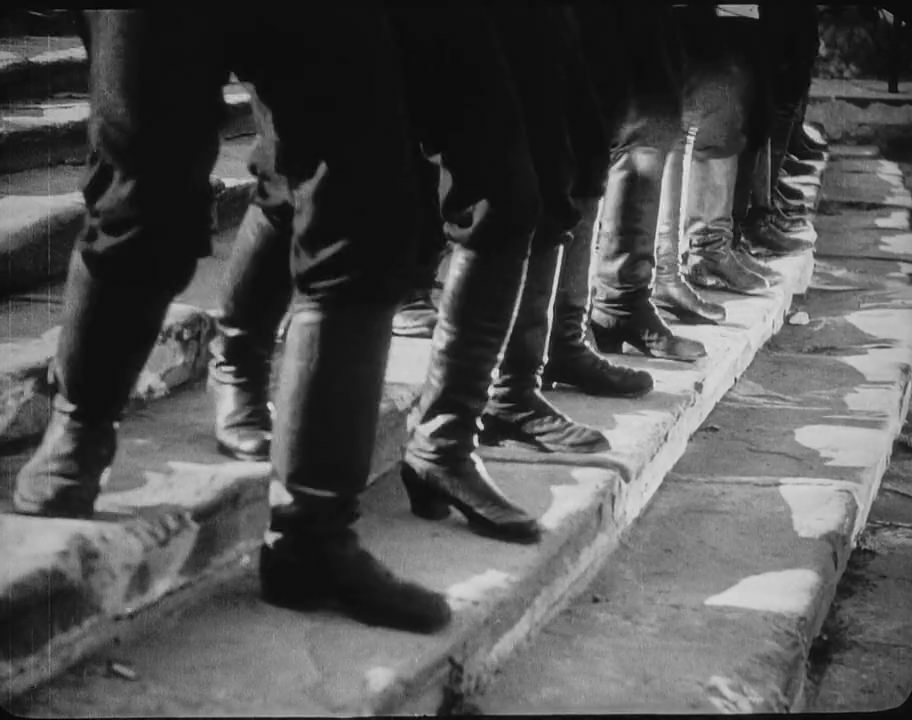
- Battleship Potemkin (1925). The Odessa Steps sequence shows troops firing on civilians on a long flight of steps. Eisenstein stretches the few minutes of action with repeated, overlapping shots, rhythmic marching boots and close-ups of victims, including a pram bouncing down the steps. After the massacre, three shots of stone lions (sleeping, waking, rising) seem to show a single lion leaping up in anger: the stones themselves “rise up”.
- October (1928). To mock the head of the provisional government, Eisenstein intercuts him with a mechanical peacock, and in the “gods” sequence he cuts through religious statues from many cultures, ending with crude idols, to question the idea of God through editing alone.
Eisenstein’s five methods of montage
In a 1929 essay, Eisenstein described five methods, from the simplest to the most complex.
| Method | What it is based on | Effect | Example idea |
|---|---|---|---|
| Metric | The length of shots, cut by a fixed count, regardless of content | Rhythm and tempo; shortening shots creates acceleration and tension | Shots get shorter and shorter as a march builds |
| Rhythmic | Movement within the shots as well as their length | Rhythm felt through action on screen | Marching boots cut against fleeing crowds on the Odessa Steps |
| Tonal | The dominant emotional tone of shots: light, shape, mood | An emotional atmosphere | Misty, calm harbour shots before a mourning scene |
| Overtonal | The combination of metric, rhythmic and tonal at once | A complex, layered feeling | A whole sequence designed on all three levels |
| Intellectual | Shots chosen to create an abstract idea | A concept the viewer must think through | Workers + slaughtered bull = massacre; politician + peacock = vanity |
Vsevolod Pudovkin: montage as linkage
Pudovkin, a former chemistry student, trained in Kuleshov’s workshop. He agreed that editing creates meaning, but he disagreed with Eisenstein about how. For Pudovkin, shots are linked like bricks or links in a chain to build a scene and guide the viewer’s attention and emotion step by step. Editing should lead the audience smoothly through the story, closer to the logic of a narrative.
His film Mother (1926), based on Maxim Gorky’s novel, follows a woman whose son is arrested, and is built around characters and emotion more than Eisenstein’s mass scenes. In one celebrated sequence, shots of a river’s ice breaking up in spring are intercut with a workers’ demonstration, linking the image of nature’s release to the characters’ hope.
Pudovkin’s writings, translated into English as Film Technique, describe five kinds of “relational editing”:
- Contrast: poverty against luxury.
- Parallelism: two separate lines of action linked by a common theme.
- Symbolism: an image standing for an idea, such as the breaking ice.
- Simultaneity: events happening at the same time, as in a cross-cut rescue.
- Leitmotif: a repeated image or theme that returns through the film.
Montage and documentary: Vertov, Svilova and Shub
Montage was not only for fiction. Some of its most radical uses were in documentary, which matters for anyone making non-fiction films today.
Dziga Vertov and Elizaveta Svilova
Dziga Vertov rejected acted, scripted cinema altogether. His “Kino-Eye” group made the Kino-Pravda newsreels (1922–1925) and argued that the camera, freed from human limits, could reveal reality more truly than the eye. Editing, for Vertov, happened at every stage: choosing subjects, filming and assembling. He described montage in terms of “intervals”, the movement and change between shots.
His masterpiece, Man with a Movie Camera (1929), has no actors, no story and no intertitles. It follows a day in Soviet city life and celebrates filmmaking itself, with split screens, slow and fast motion, freeze frames and very rapid cutting. It was edited by Elizaveta Svilova, Vertov’s wife and long-time collaborator, who appears on screen at her editing bench, examining film strips. Vertov’s brother Mikhail Kaufman was the cameraman.
Esfir Shub and the compilation film
Esfir Shub worked re-editing foreign films for Soviet release before making her own. The Fall of the Romanov Dynasty (1927) was built entirely from existing newsreel and archival footage, including the Tsar’s own home movies, re-arranged to tell the story of the years leading up to the revolution. She is widely seen as the pioneer of the compilation documentary, the ancestor of every archive-based documentary today. Her work also raises a question documentary makers still face: the same footage, re-edited, can tell a very different story from the one its original makers intended.
Alexander Dovzhenko
From Ukraine, Alexander Dovzhenko brought a more poetic, lyrical approach. Arsenal (1929) and Earth (1930) use montage to link people, land and nature in long, rhythmic, almost musical sequences, closer to poetry than argument.
The end of the movement
Soviet montage flourished for barely a decade. Two things ended it:
- Sound. When synchronised sound arrived, dialogue pushed films towards realistic, continuous scenes. In 1928 Eisenstein, Pudovkin and Grigori Alexandrov signed a statement calling for sound to be used in counterpoint to the image, not just to record speech, but that approach lost out.
- Politics. Under Stalin, the official style of socialist realism, adopted in 1934, demanded clear, accessible, heroic stories. Experimental montage was attacked as “formalism”, meaning it put style above content. Eisenstein’s film Bezhin Meadow was halted in 1937, and filmmakers were pressured to conform.
Eisenstein kept writing and teaching, and his later films such as Alexander Nevsky (1938) used sound and music in carefully designed audiovisual montage, working closely with the composer Sergei Prokofiev.
Legacy: montage everywhere
- Mainstream film. Alfred Hitchcock often explained the Kuleshov effect in interviews and used its logic constantly, especially in point-of-view scenes. The baptism sequence in The Godfather (1972), cross-cutting a christening with murders, is intellectual montage in a Hollywood film. Brian De Palma’s The Untouchables (1987) openly echoes the Odessa Steps pram in a station shoot-out.
- The everyday “montage”. Training montages, travel montages and opening-title sequences compress time using rhythmic cutting that descends from these experiments.
- Advertising and music videos. Placing a product next to images of happiness, freedom or status is the Kuleshov effect at work. Music videos inherited the metric and rhythmic montage of the 1920s.
- Film theory and teaching. Montage versus continuity, and Eisenstein versus Pudovkin, remain foundational debates in film studies.
For where montage fits in the bigger story, read our history of film editing, and for the cuts themselves, types of cuts in film.
Montage, honesty and documentary ethics
The Kuleshov effect is a powerful tool, and that is exactly why documentary and NGO filmmakers need to handle it carefully. If a neutral face can be made to look grieving, hungry or guilty simply by what it is cut against, then an editor can change what a real person appears to feel or mean.
- Don’t invent reactions. Avoid cutting a contributor’s face against an image they never actually saw, in a way that suggests a reaction they never had.
- Be careful with “cutaways” of suffering. Intercutting a person’s words with images of poverty or disaster can turn them into a symbol rather than a person.
- Archive footage carries its own context. Like Esfir Shub, you can re-use archive footage to tell a new story, but don’t misrepresent where and when it was filmed.
- Ask: would the person recognise themselves? If the contributor watched the edit, would they agree that it is fair to what they said and felt?
See NGO documentary filmmaking for more on filming with people, not about them.
Try it yourself
Film a friend looking at the camera with a neutral expression for five seconds. Then film three other short shots: food, an empty chair, and something funny (a dog, a cartoon on a screen). Edit three versions, each with the face followed by one of the shots. Show them to people who haven’t seen the others, and ask what the person in the first shot is feeling. Then write two sentences on what this means for editing interviews in documentary.
- Montage
- Editing; in Soviet theory, the creation of meaning by juxtaposing shots.
- Kuleshov effect
- Viewers read emotion or meaning into a shot depending on the shots around it.
- Creative geography
- Using editing to make shots filmed in different places appear to be one continuous space.
- Intellectual montage
- Eisenstein’s term for shots combined to produce an abstract idea.
- Montage of attractions
- Eisenstein’s idea of building a work from strong, calculated moments that act on the audience.
- Compilation film
- A documentary made by re-editing existing footage, pioneered by Esfir Shub.
- Formalism
- In Soviet cultural politics, an accusation of valuing artistic form over approved content.
Quick recap
- Soviet montage (1920s) holds that meaning is created by the juxtaposition of shots, not by single shots.
- Kuleshov’s workshop showed that context changes how we read a face and that editing can invent space.
- Eisenstein saw montage as collision and described five methods, from metric to intellectual montage.
- Pudovkin saw montage as linkage, building scenes step by step through relational editing.
- Vertov, Svilova and Shub brought montage to documentary; Shub pioneered the compilation film.
- Sound and Stalin-era politics ended the movement, but its ideas shape film, TV, advertising and documentary ethics today.
FAQ
What is Soviet montage theory in simple words?
It is the idea that a film’s meaning comes from how shots are put together. Two images placed side by side create a new meaning, feeling or idea in the viewer’s mind that neither image has on its own.
What is the difference between Eisenstein’s and Pudovkin’s montage?
Eisenstein believed shots should collide and conflict to spark new ideas (montage as collision). Pudovkin believed shots should be linked smoothly, like bricks, to build scenes and guide the audience’s emotions (montage as linkage).
Is the Kuleshov effect real?
Yes, but it is weaker than the famous story suggests. The original footage is lost, and modern experiments have found that context shots do change how people read a neutral face, though by a modest amount.
What are Eisenstein’s five methods of montage?
Metric (shot length), rhythmic (length plus movement), tonal (emotional tone), overtonal (all three combined) and intellectual (shots combined to create an abstract idea).
How is Soviet montage different from continuity editing?
Continuity editing hides cuts so the story flows smoothly in space and time. Soviet montage makes cuts noticeable and uses them to create meaning, emotion and argument.
Sources and further reading
- Sergei Eisenstein, Film Form and The Film Sense, edited and translated by Jay Leyda (Harcourt). Includes “The Cinematographic Principle and the Ideogram” and “Methods of Montage”.
- V. I. Pudovkin, Film Technique and Film Acting, translated by Ivor Montagu.
- Lev Kuleshov, Kuleshov on Film: Writings, edited and translated by Ronald Levaco (University of California Press, 1974).
- David Bordwell, Kristin Thompson and Jeff Smith, Film Art: An Introduction (McGraw-Hill), and Thompson and Bordwell, Film History: An Introduction, chapters on Soviet montage.
- Daniel Barratt, Anna Cabak Rédei, Åse Innes-Ker and Joost van de Weijer, “Does the Kuleshov Effect Really Exist? Revisiting a Classic Film Experiment on Facial Expressions and Emotional Contexts”, Perception (2016). doi.org/10.1177/0301006616638595
- Soviet montage theory and Kuleshov effect (Wikipedia), with their own source lists.