Ask who taught movies to cut and two American names come up: Edwin S. Porter and D. W. Griffith. Porter showed that a story could unfold across many shots. Griffith showed that the way you join those shots could make an audience’s heart race. Both are often given credit for things they did not invent, and one of them made one of the most damaging films in history. Here is what each actually contributed, and how to judge it fairly.
In this guide
- Who Porter and Griffith were, and the world they worked in
- Porter’s key films: Life of an American Fireman and The Great Train Robbery
- The two-versions puzzle and what it tells us about early editing
- Griffith at Biograph: cross-cutting, contrast and closer shots
- The Birth of a Nation and Intolerance: craft and harm
- Myths, influences and a balanced evaluation
Setting the scene: film around 1900
By 1900 most films were still a single shot, or a few scenes joined like slides in a show, each filmed from one fixed distance. In Britain, filmmakers such as George Albert Smith and James Williamson had begun cutting to close-ups and following action from shot to shot (see our history of film editing). In France, Georges Méliès was building multi-scene fantasies. American studios watched and copied these films closely, because copyright protection for films was weak and copying was common.
Porter and Griffith worked inside this busy, international exchange of ideas. That is the first thing to remember when you evaluate them.
Edwin S. Porter (1870–1941)
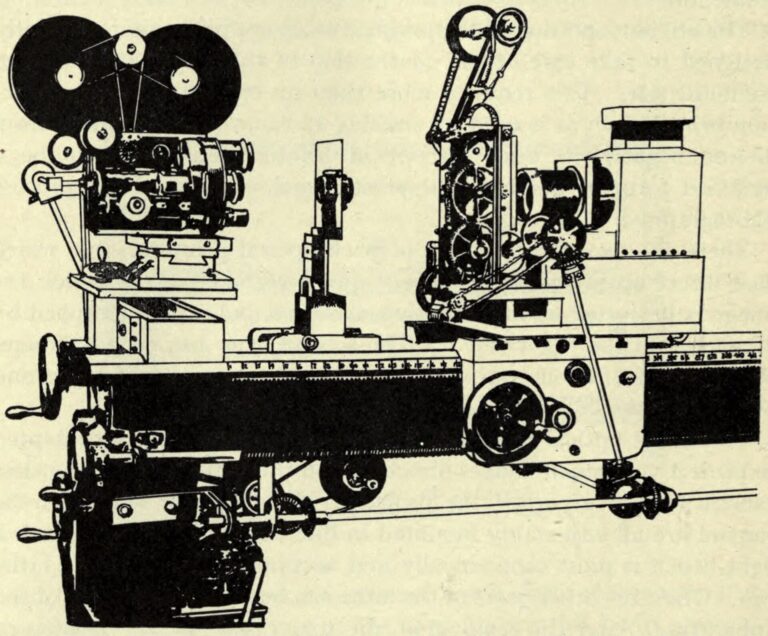
Porter was a projectionist and electrician before he joined Thomas Edison’s film company in New York around 1900. He worked as cameraman, director and, effectively, editor, as was normal then. Film historian Charles Musser’s detailed study of Porter at Edison is the standard source on his work.
Life of an American Fireman (1903)
The film shows a fire chief dreaming of a mother and child in danger, the fire alarm, firefighters racing out and a dramatic rescue from a burning house. Porter combined new scenes with existing Edison footage of real fire departments, an early example of building a story from material shot at different times.
The interesting part is the rescue. The print that Edison deposited for copyright shows it twice: first from inside the bedroom (a firefighter enters through the window, carries the mother out, comes back for the child), and then the whole action again from outside the house. A different version, which circulated for many years, intercuts the inside and outside views into one continuous rescue.
The Great Train Robbery (1903)
This is Porter’s most famous film and one of the most successful films of its decade. In about twelve minutes and 14 shots, bandits tie up a railway telegraph operator, rob a train and its passengers, escape on horseback and are hunted down by a posse.
What it achieved for editing:
- A clear story across many shots. Each shot moves the plot forward, and the audience follows it without titles explaining every step.
- Movement between locations. The film cuts from the telegraph office to the water tower, the train, the countryside and a dance hall. Much of it was shot outdoors, in New Jersey.
- Leaving one line of action for another. The film leaves the bandits to show the telegraph operator being found and freed, then the posse forming at the dance hall, before returning to the chase. This is an early step towards parallel storytelling, though it is not yet the rhythmic back-and-forth cross-cutting Griffith would develop.
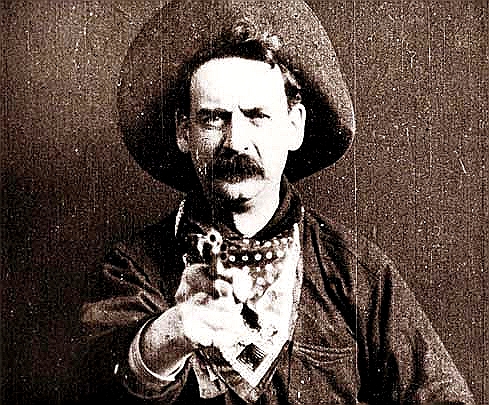
- The famous close-up. A medium close-up of an outlaw (the actor Justus D. Barnes) firing his revolver straight at the camera is not part of the story. Edison’s catalogue told exhibitors they could show it at the beginning or the end. It shows that a shot was still seen as a separate attraction, not a piece of the scene.
Porter’s later work
Porter kept experimenting. The Kleptomaniac (1905) contrasts a rich woman and a poor woman who both steal, and the very different ways the courts treat them. Dream of a Rarebit Fiend (1906) uses trick photography and superimpositions. But Porter did not develop editing much further. He did not adopt the closer, faster, scene-dissecting style that others were moving towards. In 1912 he joined Adolph Zukor in the Famous Players company, and he left filmmaking a few years later.
D. W. Griffith (1875–1948)
David Wark Griffith was a struggling stage actor and writer. In 1908 he acted in an Edison film made by Porter’s unit, then joined the rival American Mutoscope and Biograph Company, where he quickly became its main director. Between 1908 and 1913 he directed hundreds of one- and two-reel films, most of them shot by cameraman G. W. “Billy” Bitzer. That volume matters: making two or three short films a week gave Griffith a laboratory in which to test ideas constantly.
Cross-cutting and the last-minute rescue
Griffith’s best-known contribution is turning cross-cutting (also called parallel editing) into a reliable engine of suspense. The Lonely Villa (1909) cuts between three places: a mother and her daughters locked inside their house, burglars breaking through the doors, and the father racing back to save them. As the climax approaches, the shots get shorter and the cutting between them faster. The audience feels the danger growing, and the cutting itself creates the suspense.
The Lonedale Operator (1911) refines the formula: a young telegraph operator holds off thieves while her engineer sweetheart races a train to the rescue. It uses closer shots of hands and objects, including the wrench she points like a gun, so the audience understands each step of the action.
Contrast and meaning
A Corner in Wheat (1909) shows that cutting can make an argument. Griffith cuts between a greedy speculator who corners the wheat market, celebrating at a lavish banquet, and poor people turned away from a bakery because bread prices have soared. No title has to state the moral. Putting the shots side by side does it.
Closer shots and performance
Griffith moved the camera closer to actors at important moments and broke scenes into shots of different sizes. This let audiences read small expressions, and it encouraged a more restrained, natural acting style than the broad stage gestures needed in wide shots. Actors such as Lillian Gish became stars partly because the camera could now see their faces.
The Birth of a Nation (1915)
Griffith’s first major feature combined all of his techniques across roughly three hours: large battle scenes, cross-cut rescues, close-ups, irises, and a carefully controlled rhythm. It was a huge commercial success and helped convince the industry that long feature films were the future.
It is also a racist film. It portrays Black Americans, many played by white actors in blackface, as dangerous and incapable, and presents the Ku Klux Klan as heroic rescuers. The NAACP campaigned against it when it was released, and its popularity helped inspire the Klan’s revival in 1915. Its famous climax, a cross-cut ride to the rescue, puts Griffith’s most celebrated editing technique directly at the service of that message.
Intolerance (1916)
Partly in response to criticism of The Birth of a Nation, Griffith made Intolerance, which intercuts four stories set in ancient Babylon, Judea in the time of Jesus, sixteenth-century France and modern America. The stories are linked by a repeated shot of a woman (Lillian Gish) rocking a cradle. As the film approaches its climax, Griffith cuts between all four stories faster and faster, joining them through ideas rather than through space or time. Audiences found it confusing and it lost money, but Soviet filmmakers studied it closely, and its approach to intercutting ideas fed into Soviet montage. Sergei Eisenstein later wrote an essay, “Dickens, Griffith, and the Film Today” (1944), tracing Griffith’s parallel editing back to the novels of Charles Dickens.
Myths to avoid
| Common claim | What historians say |
|---|---|
| Porter invented cross-cutting in Life of an American Fireman. | The cross-cut version is probably a later re-edit. The copyright print repeats the rescue from two viewpoints. |
| The Great Train Robbery was the first story film. | Story films existed earlier in France and Britain. It was the most influential early American one. |
| Griffith invented the close-up. | Close-ups appear in British and French films before 1908. Griffith claimed many “firsts” in a 1913 trade-paper advertisement, and the claims stuck. |
| Griffith invented film grammar on his own. | He refined and combined existing techniques with collaborators, especially Billy Bitzer, and he did it more consistently and dramatically than anyone else at the time. |
Porter vs Griffith: a side-by-side evaluation
| Edwin S. Porter | D. W. Griffith | |
|---|---|---|
| Main period | 1901–1912, Edison company | 1908–1920s, Biograph, then independent features |
| Key films | Life of an American Fireman, The Great Train Robbery, The Kleptomaniac | The Lonely Villa, A Corner in Wheat, The Lonedale Operator, The Birth of a Nation, Intolerance |
| Unit of editing | The scene: each shot is usually a complete action | The fragment: scenes broken into several shots |
| Biggest contribution | Showed that a popular story could be told across many shots and locations | Made cross-cutting, contrast and closer shots into a system for suspense and emotion |
| Time and space | Mostly linear, with some overlapping or repeated action | Simultaneous actions in different places; later, ideas across centuries |
| Limits | Did not develop scene breakdown or rhythm much further | Melodramatic; racist content in The Birth of a Nation; overstated his own originality |
| Influence | Proved the commercial power of the narrative film; widely copied Westerns and crime films | Shaped Hollywood continuity editing and Soviet montage |
A balanced verdict
Porter’s importance is as a bridge. The Great Train Robbery took the multi-shot story out of experiments and into a mass-market hit, and it showed American producers that audiences would follow a plot across space without being told every step. But Porter still thought in complete scenes. He arranged shots; he did not yet shape time inside them.
Griffith’s importance is as a systematiser. He did not invent the close-up or cross-cutting, but over hundreds of films he worked out how to combine shot size, cutting rhythm and parallel action so that editing itself produced suspense, empathy and meaning. That approach became the backbone of the continuity system and, through Intolerance, a starting point for Soviet montage. His legacy is also inseparable from The Birth of a Nation, which shows how persuasive editing can be when it serves propaganda.
Put simply: Porter showed that shots could tell a story; Griffith showed that the way shots are joined could make the audience feel it.
Quick recap
- Neither man worked alone: British and French filmmakers had already cut to close-ups and followed action across shots.
- Porter’s The Great Train Robbery (1903) told a clear story in 14 shots across many locations and was a huge hit.
- The cross-cut version of Life of an American Fireman is probably a later re-edit; the original repeated the action.
- Griffith developed cross-cutting for suspense, contrast editing and closer shots at Biograph (1908–1913).
- The Birth of a Nation (1915) was technically influential and openly racist; Intolerance (1916) intercut ideas across time and influenced Soviet montage.
FAQ
What is Edwin S. Porter best known for?
For directing The Great Train Robbery (1903), an early and hugely popular story film told in 14 shots, and Life of an American Fireman (1903). Both helped establish the multi-shot narrative film in America.
What editing technique is D. W. Griffith famous for?
Cross-cutting, also called parallel editing: cutting back and forth between actions in different places to build suspense, especially in last-minute rescues. He is also known for contrast editing and for using closer shots at emotional moments.
Did Griffith work with Porter?
Briefly and indirectly. Griffith acted in an Edison film made by Porter’s unit in 1908, Rescued from an Eagle’s Nest, shortly before he moved to Biograph and began directing.
Why is The Birth of a Nation still studied?
Because it consolidated many editing and storytelling techniques that shaped feature films, and because it is a key case study in how film can spread racist propaganda. Responsible teaching addresses both.
Sources and further reading
- Charles Musser, Before the Nickelodeon: Edwin S. Porter and the Edison Manufacturing Company (University of California Press, 1991).
- Tom Gunning, D. W. Griffith and the Origins of American Narrative Film: The Early Years at Biograph (University of Illinois Press, 1991).
- Kristin Thompson and David Bordwell, Film History: An Introduction (McGraw-Hill).
- Sergei Eisenstein, “Dickens, Griffith, and the Film Today” (1944), in Film Form, ed. Jay Leyda.
- The Great Train Robbery (1903 film) (Wikipedia), with its own source list.
- Life of an American Fireman and D. W. Griffith (Wikipedia), with their own source lists.